2009 Pellet and Biomass Stove Tax Credit Information
– Important New Details
This article may have updates since it's publication.
Visit HPBA for recent updates. The following information
was compiled by HPBA Used with permission from
the HPBA
Included in the 2009 Economic Stimulus legislation
signed into law by President
Barrack Obama on February 17th, 2009, is a
30% (up to $1,500) consumer tax credit in 2009
and 2010 for the purchase of a 75% efficient biomass-burning
stove as measured using a lower heating value.
The Hearth, Patio & Barbecue Association (HPBA)
and the Pellet Fuels Institute (PFI), succeeded
in their efforts improving the tax credit to promote
renewable energy and help consumers fight rising
year to year home heating costs.
The pellet
stove biomass tax credit provisions in this
new legislation contain improvement amendments
to the legislation passed back in October 2008.
The major changes made were an extension of the
credit to 2010 and an increase of the credit from
$300 to 30% of the total cost of stove.
Guidelines for determining what pellet stoves
and biomass stoves meet the efficiency requirements
to qualify for the credit or how a pellet stove
manufacturer will qualify their products are determined
by the U.S. Department of the Treasury and the
Internal Revenue Service (IRS). The pellet / biomass
tax credit took effect January 1st, 2009, though
the IRS has not issued the official guidelines.
These guidelines are expected to be out by March
31, 2009, however the credit applies to all qualifying
pellet or biomass stoves sold in 2009 and 2010.
HPBA will keep the industry informed on the status
of the guidelines for qualifying stoves. For the
latest information, check the HPBA website, www.hpba.org,
for critical developments.
Tax Credit Frequently Asked Questions:
Q: What is a federal consumer tax credit?
A: Consumers claim the credit on their federal
income tax form at the end of the year. The credit
then increases the tax refund or decreases the
amount the taxpayer has to pay.
Note: With regard to tax credits vs. tax deductions,
in general, a tax credit is more valuable than
a similar tax deduction. A tax credit reduces
the tax you pay, dollar-for-dollar. Tax deductions
- such as those for home mortgages and charitable
giving - lower your taxable income.
Q: When does this pellet / biomass tax credit
go into effect and how long will it last?
A: The pellet / biomass tax credit goes into effect
January 1st, 2009 and is valid only for the purchase
of a qualifying biomass-burning stove in 2009
and 2010. The sales receipt must indicate that
the purchase was made between January 1, 2009
and December 31, 2010. If a retailer sells a stove
before the list of qualifying pellet or biomass
stoves is made public, the retailer must keep
a complete record of the sale (name and full contact
information) so the purchaser can be notified.
Q: Who is determining the pellet -biomass tax
credit guidelines for the qualifying units?
A: The Department of the Treasury, and the IRS.
Q: Will other wood and solid-fuel appliances (like
inserts, EPA-certified wood-burning fireplaces
and outdoor wood heaters) qualify for the tax
credit?
A: This legislation includes only 75% efficient
biomass-burning stoves. In communication with
the IRS, HPBA requested that inserts be included,
but no confirmation has been received.
Q: Will all pellet stoves qualify for the tax
credit?
A: We do not know at this time. In a letter to
the IRS, we recommended that all pellet stoves
be included because EPA has previously assigned
a default efficiency rating sufficient to qualify
pellet appliances. However, we do not have a confirmation
from the U.S. Department of the Treasury or the
IRS about whether they will accept or reject this
recommendation.
Q: Why was 75% efficiency selected?
A: The 75% efficiency number was approved by the
U.S. Congress in 2005 as part of the Energy Policy
Act and was used again for this pellet - biomass
tax credit. Unfortunately, with a truncated timeline
of the legislation that included this tax pellet-biomass
stove credit, we were not able to change the number
to reflect a more realistic efficiency rating.
Q: How will the 75% efficiency requirement be
determined?
A: The 2009 Economic Stimulus legislation, signed
into law on February 17, 2009, stated that a lower
heating value will be used to measure the efficiency
of a pellet / biomass-burning stove. HPBA has
provided the IRS with extensive information on
product efficiency. This method will include a
broader range of efficient biomass products for
the pellet - biomass tax credit and be consistent
with the original legislative intent.
Q: How will a consumer know that a product is
certified?
A: The manufacturer will have to certify that
its product meets or exceeds the IRS efficiency
requirements. A manufacturer’s certification
is a signed statement from the manufacturer certifying
that the product qualifies for the pellet - biomass
tax credit. The IRS encourages manufacturers to
provide these certifications on their websites
to facilitate identification of qualified products.
Tax payers must keep a copy of a certification
statement for their records, but do not have to
submit a copy with their tax return.
Q: What should a retailer and consumer do while
waiting for qualifying information?
A: Keep exact records of any sale or pellet stove
, biomass stove purchase. It is imperative that
retailers keep records of sales and buyers should
save all receipts for payment along with the pellet
stove manufacturer and model information.
Q: How does the language in this legislation differ
from what was passed in October 2008?
A: The new legislation 1) increases the pellet
- biomass tax credit from $300 to 30% of the total
cost of a biomass-pellet burning stove, 2) extends
the tax credit to purchases in 2010, and 3) measures
the pellet-biomass
stove’s efficiency based on the lower
heating value.
This article may have updates since it's publication.
Visit HPBA for recent updates. The following information
was compiled by HPBA Used with permission from
the HPBA
|

WoodPelletFuel.net
Place a wood pellet classified
Update or place a new wood pellet classified to our directory.

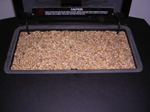
Hopper load of fuel. The average hopper holds 50lbs.
Pellet Stove Guide
------------------------
Wood Pellet Fuel is now heating over 900,000
residential homes in the United States
|